
Most junk removal businesses start with a van, a phone and word of mouth. Growing beyond that takes a plan. This one runs over 90 days and builds from the cheapest foundations to paid channels, so every pound you spend on ads lands on a business that already looks trustworthy and answers quickly.
The market you are in
| Fact | Figure | Source |
|---|---|---|
| Fly-tipping incidents in England, 2024/25 | 1.26 million (up 9%) | Defra, Feb 2026 |
| Share involving household waste | 62% | Defra |
| Most common size | Small van load (31%) | Defra |
| Waste carrier registration fee (England) | £191.02 | GOV.UK |
| Full van load (rest of UK) | £250 to £400+ | Fantastic Services, 2026 |
| 3-bed house clearance (rest of UK) | £600 to £1,200 | Fantastic Services, 2026 |
Two things stand out. Customers are wary, because so much waste ends up dumped by unlicensed collectors. And jobs range from £60 single items to £1,000+ clearances. Good marketing uses the first to win the second.
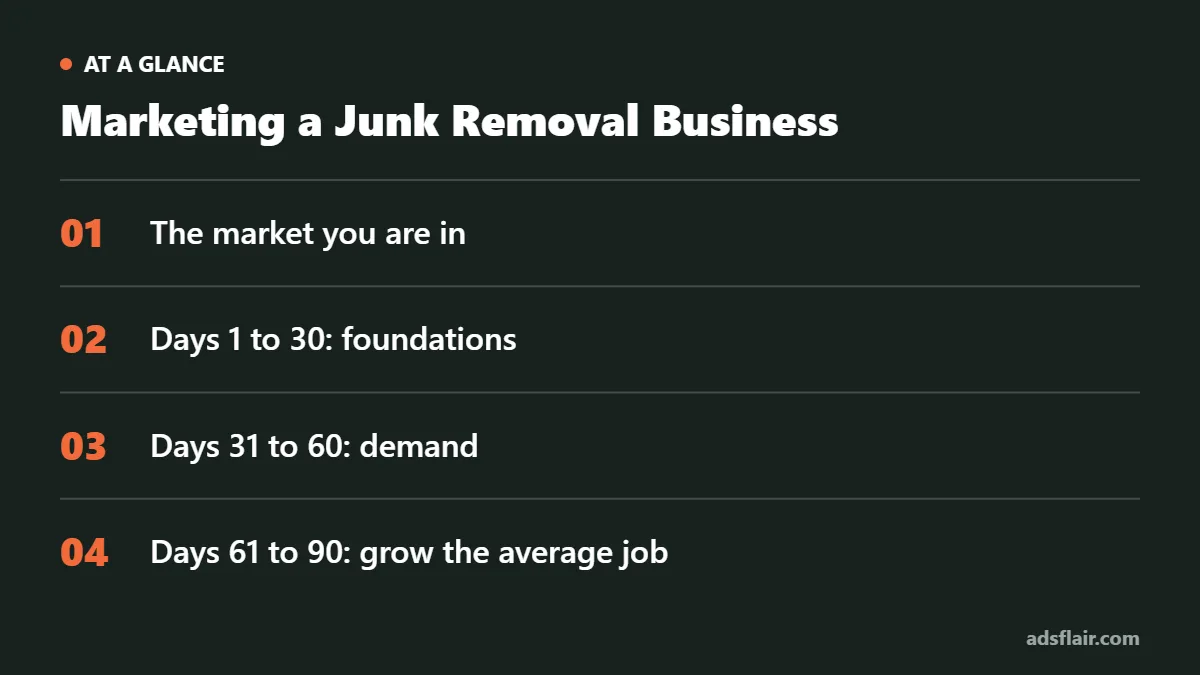
Days 1 to 30: foundations
Make compliance your selling point
Every business transporting waste in England must register as a waste carrier, and GOV.UK warns of an unlimited fine for not registering. Householders can also be penalised if they give waste to someone who fly-tips it. So say it loudly: show your registration number on your van, website, Google profile and quotes. Explain where waste goes, what you recycle or donate, and that you give a waste transfer note. Cheap collectors cannot match that.
Pick your core services and area
Decide what you want more of: single-item collections, garden clearances, house clearances, probate work or commercial. Define the postcodes you can serve the same or next day. Everything else in the plan follows from these choices.
Set up your Google Business Profile
Service-area business, accurate category, every service listed with a "from" price, photos of your van, team and before-and-after jobs, and opening hours you can keep. Google reports that complete profiles make customers 2.7 times more likely to see a business as reputable.
Build simple service pages
One page per core service, each with prices by load size, photos, the areas you cover, your registration, reviews and a photo-quote form. Make the phone number tap-to-call.
Days 31 to 60: demand
Launch Google Search ads
Start with ad groups for your top two or three services, phrase and exact match keywords, a strong negative list (council, tip, free, skip hire, jobs), and call tracking. Keep the area tight. Check the search terms twice a week.
Build partner relationships
- Letting and estate agents: end-of-tenancy and pre-sale clearances.
- Solicitors and probate specialists: house clearances that need care and discretion.
- Builders, kitchen fitters, landscapers: construction and garden waste.
- Removal firms and storage companies: decluttering before moves.
Leave a one-page price sheet and your registration details. Follow up in a fortnight.
Start a review routine
Text every customer a direct review link the same day. Reply to every review. In BrightLocal's 2025 survey, 63% of consumers expected a reply within two or three days to a week.
Days 61 to 90: grow the average job
Promote clearances
Run a spring or new-year campaign for garage, loft and shed clearances with before-and-after photos on Facebook, Instagram and your Google profile. These are bigger jobs and they photograph well.
Upsell on the day
Once you are on site, ask: "Anything else in the garden or garage while we are here?" A quarter load that becomes a half load nearly doubles the job value with little extra time.
Work the street
Neighbours watch the van being loaded. Leave a card next door: "We cleared number 12 today. Need anything taken while we are in the area?"
Numbers to track every week
| Metric | Why it matters |
|---|---|
| Enquiries by source | Shows which channels work |
| Reply time | Fast replies win most jobs |
| Quote to booking rate | Shows whether price or trust is the issue |
| Average job value | Shows whether you are winning clearances or single items |
| Ad cost per booked job | Decides where budget goes next |
| Reviews gained | Drives map ranking and trust |
After 90 days
Look at which service and channel gave the best cost per booked job and the highest average value. Put more budget there, cut what did not work, and consider adding commercial contracts for steady weekday work.
Frequently asked questions
How do I market a junk removal business?
Start with compliance and trust (show your waste carrier registration), a complete Google Business Profile, simple service pages with prices, then Google Search ads, partner referrals and a steady review routine.
Do junk removal businesses need a licence?
Businesses transporting waste in England must register as a waste carrier with the Environment Agency. The registration fee is £191.02, and GOV.UK warns of an unlimited fine for not registering.
How can I increase my average junk removal job?
Promote clearances, quote by load size, and ask about other rubbish while on site. Turning a quarter load into a half load nearly doubles the job value.
Who are good referral partners for junk removal?
Letting and estate agents, probate solicitors, builders and kitchen fitters, landscapers, and removal or storage firms.
Related guides
Sources
- GOV.UK, Fly-tipping statistics for England, 2024 to 2025 (25 February 2026)
- GOV.UK, Register or renew as a waste carrier, broker or dealer (England)
- Fantastic Services, rubbish removal cost guide (updated 24 September 2026)
- Fantastic Services, house clearance cost guide (updated 24 September 2026)
- Circular Online, "Householders face £400 fine for waste duty of care failure" (27 November 2018)
- Google Business Profile Help: complete profile statistics
- BrightLocal, Local Consumer Review Survey 2025
Want a marketing plan built around your area?
Ask for a free review. We will look at your Google profile, website and ads and tell you which steps will bring bookings fastest.
Get My Free Google Ads Reviewor book a 30-minute call or message us on WhatsApp