
AI Max for Google Ads (AI Max for Search) is Google's biggest change to Search campaigns in years, and by autumn 2026 many local businesses have it switched on whether they chose to or not. For a plumber, roofer or cleaning company with a tight budget and a defined service area, the question is practical: does it bring more jobs, or does it spend the budget on searches you would never have chosen?
This guide explains what AI Max does, what changed in 2026, what the published tests show, and how we decide whether to use it on a local service account.
What AI Max is
AI Max is not a new campaign type. It is a setting inside an existing Search campaign, announced by Google in May 2025, that adds three features:
| Feature | What it does | Can you turn it off? |
|---|---|---|
| Search term matching | Extends your keywords to related searches they would not normally match, similar to a stronger broad match | Yes, at ad group level |
| Text customisation | Writes headlines and descriptions from your landing pages, ads and keywords (replacing "automatically created assets") | Yes, at campaign level |
| Final URL expansion | Sends people to whichever page on your site Google thinks matches the search best | Yes, at campaign level |
It also comes with controls: brand inclusions and exclusions, location-of-interest targeting at ad group level, URL exclusions and the ability to remove generated assets.
What Google claims
At launch, Google said advertisers using AI Max in early tests saw on average 14% more conversions or conversion value at a similar cost per acquisition or ROAS, rising to around 27% for campaigns that mostly used exact and phrase match keywords. These are Google's own figures from its own tests, so they are a ceiling to test against, not a guarantee.
What independent testing has shown
Independent results have been more mixed. In August 2025, an analysis by the director of paid search at the agency Monks, covering around 30,000 AI Max search terms across several client accounts, reported that 99% of AI Max impressions had produced no conversions, 31% of matched search terms were longer than 25 characters, and fewer than half of the search terms could be tied back to a keyword (PPC Land, August 2025). Published case studies from brands showed improvements, but without disclosed methodology.
The honest summary: AI Max can find extra conversions in accounts with strong conversion data and broad offers. In small, local accounts with limited data, it can just as easily find expensive, loosely related searches.
What changed in 2026
September 2026: Google automatically upgraded Search campaigns using campaign-level broad match or automatically created assets to AI Max, with upgrades expected to finish by 30 September. Upgraded campaigns had search term matching switched on, plus text customisation where automatically created assets were used. February 2027: Dynamic Search Ads are scheduled to move to AI Max. (Digital Applied, updated October 2026)
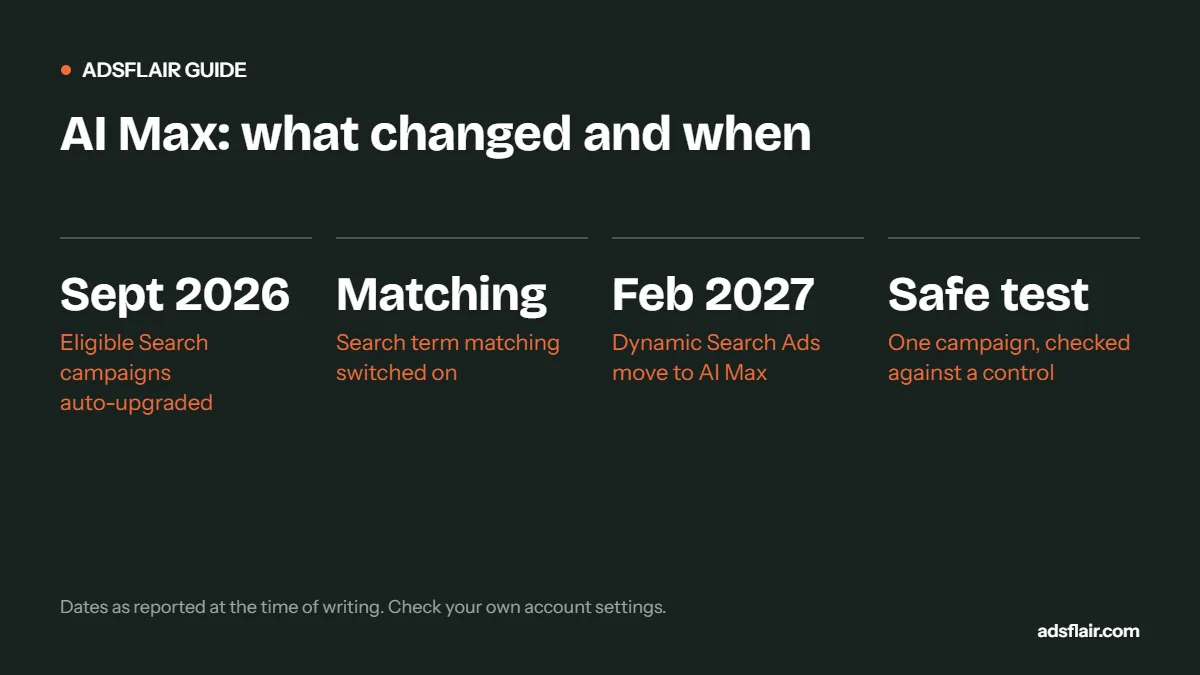
If your campaign used either of those features, check it now. Many local advertisers do not realise AI Max is running until they see unfamiliar search terms or landing pages in their reports.
Why local service businesses need to be careful
Small budgets have little room for exploration
A £30 a day account cannot afford many expensive experiments. If AI Max spends 30% of it on loosely related searches, that can be the difference between a profitable month and a loss.
Conversion data is often thin or wrong
AI features learn from your conversions. If your tracking counts short calls or button clicks as leads, AI Max will optimise towards more of those. Fix tracking first.
Final URL expansion can send people to the wrong page
For a trade website with blog posts, an about page and old service pages, Google may decide a blog article is the best match for "emergency electrician near me". That rarely converts. Use URL exclusions or switch URL expansion off unless your site is made up of strong service pages.
Generated text can promise what you do not offer
Text customisation writes ad copy from your site. If an old page mentions 24-hour service you no longer provide, that can appear in an ad. Review assets regularly and remove anything inaccurate.
When to turn AI Max on
- Conversion tracking counts real enquiries, ideally with booked jobs imported.
- The campaign has steady volume, as a rough guide 30 or more conversions a month.
- Your exact and phrase keywords are already working and you want more reach.
- Your website has clear service pages and no thin or outdated pages that could be used as landing pages.
- You can review search terms weekly during the test.
When to keep it off
- New accounts, or accounts with fewer than about 15 tracked conversions a month.
- Budgets under roughly £1,000 a month, where every pound needs to be on core searches.
- Services with strict geographic or job-type limits that broad matching ignores.
- Accounts where conversion tracking has not been checked recently.
How to test it safely
- Fix tracking so only genuine enquiries are primary conversions.
- Use a Google Ads experiment on one campaign: original against AI Max, 50/50 split.
- Turn off final URL expansion at first, or add URL exclusions for blog and info pages.
- Add brand exclusions for competitors you do not want to appear for, and keep your negative keyword lists in place.
- Run for four to six weeks, then compare cost per qualified enquiry and booked jobs, not just conversions.
- Read the search terms every week. If junk appears, add negatives or switch search term matching off at ad group level.
Our default for local trades
For most small local service accounts, we keep core campaigns on phrase and exact match with AI Max off, and test it in one campaign once tracking is reliable and volume is high enough. For larger accounts with imported booked jobs, AI Max often earns a place, with URL expansion limited to service pages.
For the related question of campaign types, read Performance Max vs Search for local service businesses.
How to check whether AI Max is running on your account
- Open each Search campaign and look in campaign settings for AI Max. If it is on, you will see the search term matching, text customisation and final URL expansion options.
- In the search terms report, look for the match source column. Terms matched by AI Max are labelled separately from your keywords.
- Check the landing pages report. If blog posts, the about page or old pages appear as final URLs, URL expansion is active.
- Review the ads tab for assets you did not write.
What to look for in the first month
| Signal | Good sign | Warning sign |
|---|---|---|
| Search terms | New, relevant variations of your services | Long, vague or unrelated queries |
| Landing pages | Your service pages | Blog, about or outdated pages |
| Ad text | Accurate claims from your site | Old offers, services you no longer provide |
| Results | More qualified enquiries at similar cost per booked job | More conversions, fewer booked jobs |
Questions to ask your agency about AI Max
- Which of our campaigns have AI Max on, and since when?
- What share of spend is going to AI Max-matched search terms?
- Are any of our blog or info pages being used as landing pages?
- How are we measuring whether it helps, beyond Google's conversion count?
Want this set up and run for you? See our Google Ads management.
Frequently asked questions
What is AI Max for Search in Google Ads?
A setting for existing Search campaigns, launched in 2025, that adds search term matching beyond your keywords, AI-written ad text and final URL expansion. Each part can be switched off.
Was AI Max turned on automatically in 2026?
Google automatically upgraded Search campaigns that used campaign-level broad match or automatically created assets to AI Max in September 2026. Dynamic Search Ads are scheduled to move in February 2027.
Does AI Max work for small local businesses?
It can, but results depend on accurate conversion tracking and enough volume. Small accounts with thin data often see budget spent on loosely related searches, so test it in one campaign first.
How do I control AI Max?
Turn off search term matching per ad group, turn off text customisation or URL expansion per campaign, add URL and brand exclusions, keep negative keywords and review search terms weekly.
Related guides
- Performance Max vs Search Ads for UK Local Service Businesses
- Google Ads Not Generating Leads? 12 Reasons
- Google Ads Conversion Tracking for Local Service Businesses
Sources
- Search Engine Journal, "It’s official: Google launches AI Max for Search campaigns" (May 2025)
- PPC Land, "Google’s AI Max for Search campaigns deliver meh results, industry tests reveal" (August 2025)
- Digital Applied, AI Max unified reporting and September migration (updated October 2026)
Not sure whether AI Max is helping or hurting?
Ask for a free Google Ads review. We will check whether AI Max is running, what it is matching and where it is sending people, and recommend on or off with the evidence.
Get My Free Google Ads Reviewor book a 30-minute call or message us on WhatsApp