

Google recommends Performance Max to almost every advertiser, and many local businesses switch it on because the Google rep or an agency suggested it. Some see cheaper leads. Others see a flood of form-fills from people who never answer the phone. Both outcomes are common, and the difference usually comes down to tracking, budget and how much of the account is still running on Search.
How they differ
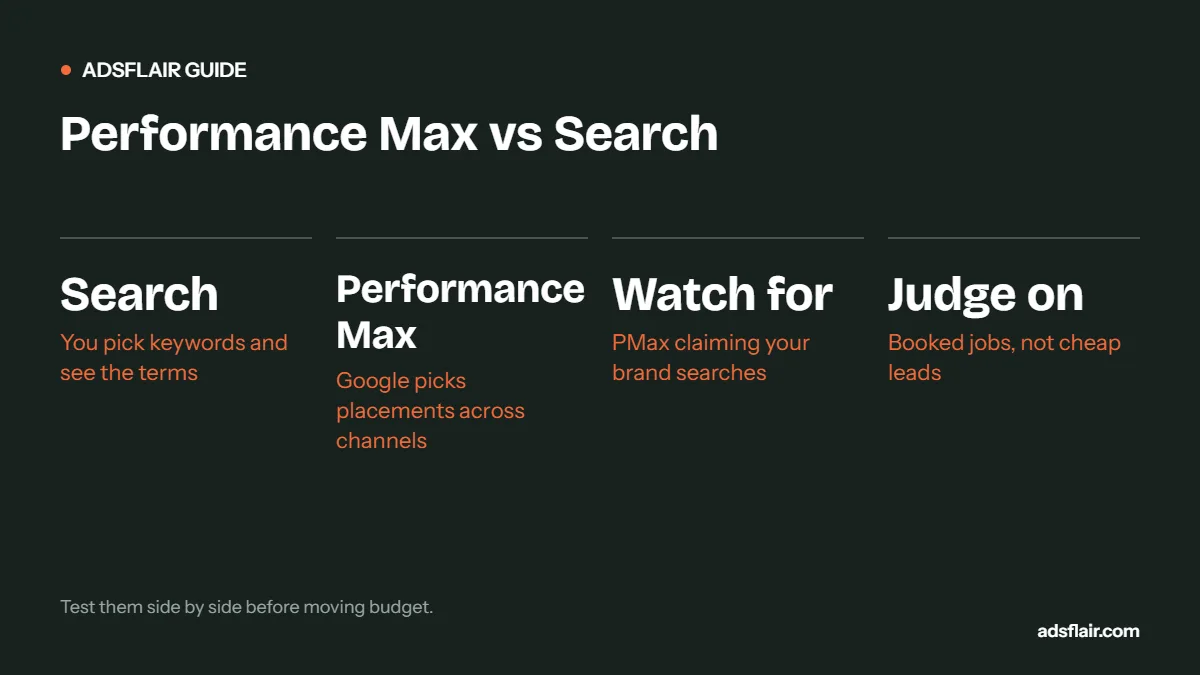
| Search campaigns | Performance Max | |
|---|---|---|
| Where ads show | Google search results (and optionally search partners) | Search, Maps, YouTube, Display, Discover and Gmail, from one campaign |
| How targeting works | Your keywords, match types and negatives | Google's AI, guided by assets, audience signals and search themes |
| Control | High: you choose searches, ads and pages | Lower: you guide, Google decides placement |
| Reporting | Full search terms and keyword data | Improved in 2025, still less granular |
| Typical lead | Someone searching for the service | A mix of searchers and people browsing other Google properties |
What changed in Performance Max in 2025
Performance Max became much easier to control during 2025. According to PPC Land's summary of Google's rollouts:
- Campaign-level negative keywords began rolling out in January 2025, with the limit raised to 10,000 negative keywords in March.
- Channel-level performance reporting and fuller search terms visibility arrived from April 2025, so you can see how much went to Search versus YouTube or Display.
- Search themes per asset group doubled from 25 to 50.
- Demographic exclusions and device targeting moved to general availability.
Those changes remove some of the strongest objections local advertisers had. They do not change the fundamental trade: Performance Max still decides more for you than Search does.
What the lead-quality data shows
There is little public UK data, but one US dataset is useful. SearchLight Digital's January 2026 figures for 816 HVAC and plumbing contractors, as reported by The AdSpend, compared campaign types:
| Campaign type | Cost per lead | Booking rate | Cost per booked job (derived) |
|---|---|---|---|
| Branded search | $34 | 55.3% | ~$61 |
| Performance Max | $72 | 32.2% | ~$224 |
| Non-branded search | $149 | 37.6% | ~$396 |
US data from one vendor's client base, not an industry-wide survey. Cost per booked job calculated as cost per lead divided by booking rate.
Two lessons come out of this. Performance Max produced cheaper leads than non-branded search and, in this dataset, a lower cost per booked job too. But its leads booked at a lower rate, and part of Performance Max spend often goes on searches for your own brand, which would have converted cheaply anyway. If PMax is quietly taking credit for brand searches, its numbers look better than its real contribution.
When Search should get most of the budget
- Budgets under about £1,500 a month. Performance Max needs data across several channels; small budgets spread thin.
- Urgent, phone-led services. Emergency plumbing, locksmiths, drainage, boiler repairs: people search, they do not browse YouTube for a plumber.
- Strict service areas or job types. Search keywords and negatives give tighter control.
- Tracking still counts all calls and forms. PMax optimises hard for whatever conversion you give it; with weak tracking it finds the easiest form-fillers.
When Performance Max earns a place
- Higher-value planned work such as solar, kitchens, landscaping and home improvements, where visual assets on YouTube and Display help people decide.
- Accounts with imported qualified leads or booked jobs as the primary conversion.
- Strong creative: real photos and short videos of your work, not stock images.
- Search already covers the core keywords well, and you want extra reach.
Set Performance Max up so it does not cannibalise Search
- Exclude your brand using brand exclusions, and run a separate brand Search campaign. Otherwise PMax claims cheap brand conversions.
- Add account-level and campaign-level negative keywords for jobs, DIY and services you do not offer.
- Use only real enquiries as conversions, ideally qualified leads imported from your CRM.
- Target presence in your area, not interest, in location options.
- Turn off final URL expansion or exclude blog and info pages.
- Check channel reporting monthly. If most spend goes to Display with few conversions, the campaign needs tighter signals or a smaller budget.
A sensible budget split
| Monthly ad budget | Search | Performance Max |
|---|---|---|
| Under £1,500 | 100% | 0% (test later) |
| £1,500 to £4,000 | 70 to 80% | 20 to 30% as a test |
| £4,000+ with booked jobs tracked | 50 to 70% | 30 to 50% |
Starting points for local service businesses. Adjust by cost per booked job after 60 to 90 days.
How to judge the test
Do not compare cost per lead alone. For each campaign, report leads, booking rate, cost per booked job and the share of spend on brand searches. If Performance Max looks cheaper but books fewer jobs, or most of its conversions are brand searches, Search is doing the real work.
For the newest automation in Search campaigns, read AI Max for Google Ads: on or off?, and for lead quality issues see Google Ads leads but no sales.
How to structure Performance Max for a local service business
Performance Max is organised into asset groups. For a local business, one asset group per main service works best, each with its own images, video, headlines and audience signals.
| Asset group | Final URL | Search themes (examples) | Audience signal |
|---|---|---|---|
| Boiler installation | /boiler-installation/ | new boiler cost, boiler replacement, combi boiler installation | Website visitors to installation pages; customer list |
| Heat pumps | /heat-pumps/ | air source heat pump installer, heat pump grant | People who visited heat pump pages |
| Servicing | /boiler-service/ | boiler service near me, annual boiler service | Past customers |
Use your own photos and short phone-shot videos of real jobs. If you do not upload a video, Google may build one from your images, and auto-generated videos rarely represent a trade business well.
Reading the channel performance report
Since 2025, Performance Max shows how spend and conversions split across Search, YouTube, Display, Discover, Gmail and Maps. For a local service account, a healthy pattern usually has most conversions coming from Search and Maps. Warning signs:
- A large share of spend on Display with few conversions, or with conversions that turn out to be accidental form-fills.
- Conversions concentrated in brand searches, which suggests PMax is taking credit for people who were already looking for you.
- YouTube spend with no view-through value you can see in booked jobs.
The brand cannibalisation check, step by step
- Open the Performance Max search terms report (or search term insights) for the last 30 days.
- Filter for your company name and common misspellings.
- Add up the conversions from those searches as a share of the campaign's total.
- If brand searches make up a large share, add a brand exclusion to Performance Max and run brand as its own Search campaign.
- Compare total conversions across the account for the four weeks before and after. If the total holds steady, PMax was mostly relabelling brand traffic.
A realistic test plan
| Week | Action |
|---|---|
| 0 | Fix tracking, set brand exclusion, add negatives, choose one service |
| 1 to 2 | Launch with 20 to 30% of budget; leave settings alone while it learns |
| 3 to 4 | Check channel and search term reports; add negatives |
| 5 to 8 | Compare cost per booked job against Search for the same service |
| 9+ | Scale, hold or stop, based on booked jobs rather than leads |
Want this set up and run for you? See our PPC management.
Frequently asked questions
Is Performance Max good for local service businesses?
It can be for higher-value planned work with strong visual assets and reliable conversion tracking. For urgent, phone-led services and small budgets, Search campaigns usually give better control and lead quality.
Can I add negative keywords to Performance Max?
Yes. Campaign-level negative keywords rolled out in 2025, with Google raising the limit to 10,000 negative keywords. Brand exclusions are also available.
Why are my Performance Max leads poor quality?
Usually because conversion tracking counts every form or call, location settings include people interested in your area, or the campaign spends heavily on Display. Import qualified leads and check channel reporting.
How should I split budget between Search and Performance Max?
Under about £1,500 a month, keep it on Search. Above that, test Performance Max with 20 to 30% of budget and compare cost per booked job after 60 to 90 days.
Related guides
- AI Max for Google Ads: Should UK Local Businesses Turn It On?
- Google Ads Leads but No Sales?
- How Much Should a UK Local Business Spend on Google Ads?
Sources
- PPC Land, "Google wraps up Performance Max feature rollouts in 2025"
- The AdSpend, Google Ads search benchmarks for HVAC (SearchLight Digital US data, January 2026)
Is Performance Max taking credit it has not earned?
Ask for a free Google Ads review. We will check how much of your PMax spend goes on brand and Display, and compare cost per booked job against your Search campaigns.
Get My Free Google Ads Reviewor book a 30-minute call or message us on WhatsApp