

For most trades, the phone is where the money is. A form says "maybe"; a call usually says "today". Yet in many accounts we audit, Google Ads call tracking is either missing altogether or set up in a way that cannot say which keyword produced the call. The account then optimises for forms, the minority of enquiries, while the calls that pay the bills are invisible.
This guide shows how to tie each call back to the keyword, how to tell a good call from a wasted one, and how to use that to move budget.
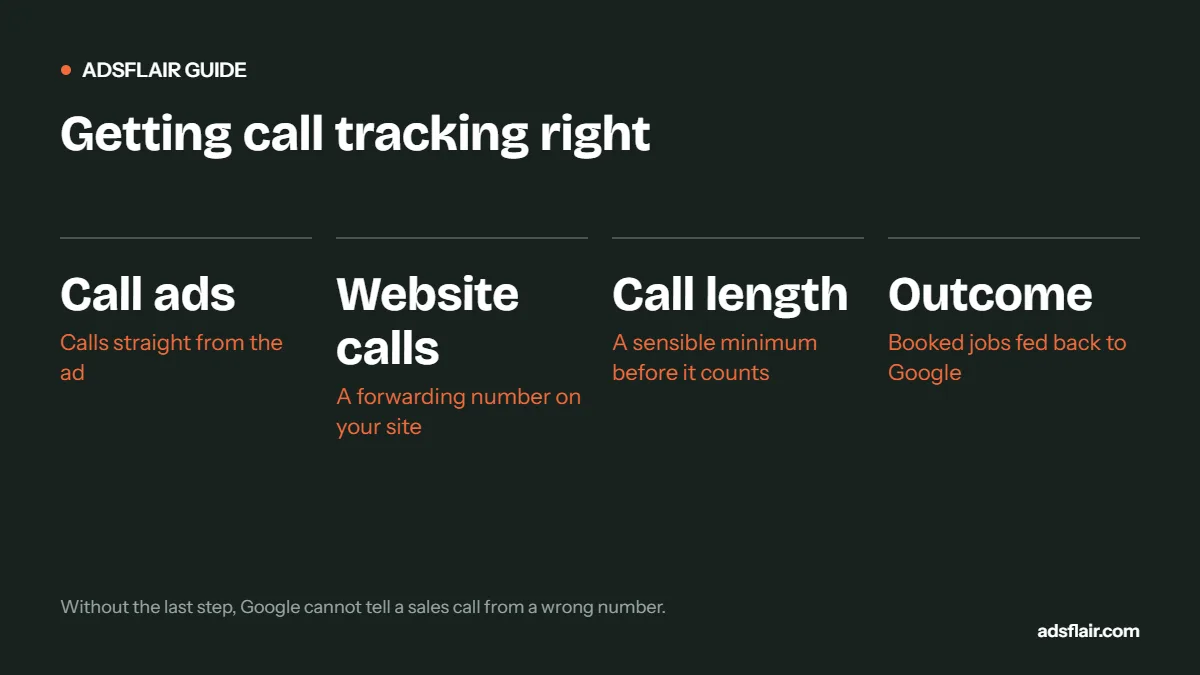
The three routes a call can take
| Route | Example | How it is tracked |
|---|---|---|
| Call from the ad | Taps the phone number in a call asset on the results page | Google call reporting with a Google forwarding number |
| Call from the website | Clicks the ad, reads the page, then rings | Website call conversions (number swap) or a call tracking tool |
| Delayed or offline call | Sees the ad, rings two days later from the van livery or Google Business Profile | Hard to attribute; ask "where did you find us?" |
The first two can be tied to a keyword. The third can only be estimated, which is why asking every caller how they found you is still worth doing.
Option 1: Google's own call tracking
Google Ads can track calls from ads and from your website. For website calls, a snippet on your site swaps your number for a Google forwarding number for people who arrived from an ad, so the call can be matched to the click. You need to be able to edit your website, and Google forwarding numbers are only available in eligible countries.
A call counts as a conversion when it lasts longer than a minimum length you set. This is the most important setting. Too short and every wrong number becomes a "lead"; too long and genuine quick enquiries are missed.
Good for: getting started at no extra cost; feeding call conversions to bidding.
Limits: no call recordings, limited caller detail, and it only covers Google Ads.
Option 2: a dedicated call tracking tool
Tools such as CallRail and similar UK providers use dynamic number insertion: each visitor sees a number from a pool, so the call can be matched to the session, the source and the keyword. Most add recordings, transcripts, caller location and the ability to tag outcomes.
Good for: businesses where calls are most of the leads; tracking calls from Google, Meta, SEO and directories in one place; quality-scoring calls.
Limits: monthly cost; needs setting up properly so numbers do not leak into Google Business Profile or citations.
Set the right minimum call length
Starting points. Listen to 20 to 30 recorded calls and pick the length at which real enquiries begin.
What to measure for each keyword
| Metric | Why it matters |
|---|---|
| Calls over threshold | The basic lead count |
| Missed call rate | Calls you paid for and never answered |
| Booked rate | Share of answered calls that became a job |
| Cost per booked call | Spend on the keyword divided by booked calls |
| Average job value | Separates cheap callouts from valuable work |
Reading the data: three common findings
"Near me" keywords bring calls; long research keywords bring forms
Searches like "plumber near me" or "emergency electrician [town]" tend to produce calls straight from the ad. Longer searches such as "cost to replace consumer unit" tend to produce page visits and forms. Both can be valuable, but they need different ads and pages.
Some keywords produce calls that never book
Words like "cheap", "free quote" or "price" can produce plenty of calls with low booking rates. Call recordings make this obvious within a few weeks. Lower bids, separate them or add qualifying lines to the ad.
Missed calls cluster at certain times
If most missed calls happen between 12pm and 2pm or after 5pm, adjust the ad schedule or put an answering service on those hours. Research by Moneypenny found 69% of callers who reach voicemail hang up without leaving a message.
Feed call outcomes back to Google
The real gain comes when Google knows which calls became jobs. Google Ads supports "Import from calls" conversion actions, so you can upload calls that resulted in a booking. Many call tracking tools can push qualified or booked calls straight into Google Ads. Over time, bidding moves towards the keywords and times that produce booked calls rather than any call.
Common mistakes
- Tracking number on Google Business Profile. Use your main number on the profile, or a dedicated tracking number set as the primary with your main number as additional, so local listings stay consistent.
- Counting phone-number clicks as calls. A tap on the number is not a connected call. Keep click-to-call as a secondary action.
- Double counting. Google's call conversions and a tool's imported calls both set as primary.
- No consent notice for recording. If you record calls, tell callers and cover it in your privacy policy.
A four-week plan
- Week 1: turn on call assets and website call tracking; set the minimum length.
- Week 2: listen to recorded calls and adjust the threshold; tag outcomes.
- Week 3: review keywords by booked calls, not total calls; add negatives.
- Week 4: start uploading booked calls and adjust ad schedules around missed-call times.
For the full measurement picture, read Google Ads conversion tracking for local service businesses, or see our PPC tracking and reporting service.
Google call tracking vs a call tracking tool
| Google Ads call tracking | Dedicated call tracking tool | |
|---|---|---|
| Cost | Included | Monthly subscription |
| Calls from ads | Yes | Yes |
| Calls from website | Yes, Google Ads visitors only | Yes, all sources (Google, Meta, SEO, directories) |
| Keyword-level attribution | Yes | Yes, via dynamic number pools |
| Recordings and transcripts | No | Usually |
| Outcome tagging | Via offline import | Built in, often pushed to Google Ads |
A sensible path for most trades: start with Google's own tracking, and move to a dedicated tool when calls are the majority of your leads or you advertise on more than one platform.
What a call log tells you that a dashboard cannot
Listening to 20 calls a month is one of the most useful habits in paid search. Recordings show you things no report can:
- whether callers mention a price from your ad, and whether it helped or hurt;
- which services people ask for that you do not advertise;
- how many callers were confused about your area;
- how the call was handled: a rushed, unfriendly answer loses jobs the ads paid for.
An example keyword review
| Keyword | Spend | Calls 60s+ | Booked | Cost per booked call | Action |
|---|---|---|---|---|---|
| emergency plumber [town] | £420 | 24 | 14 | £30 | Keep; raise budget at peak times |
| plumber near me | £310 | 19 | 8 | £39 | Keep |
| cheap plumber | £180 | 15 | 2 | £90 | Lower bid or pause |
| boiler repair [town] | £260 | 9 | 6 | £43 | Keep; check winter budget |
Illustrative example, not a benchmark.
Sorted by total calls, "cheap plumber" looks almost as good as "plumber near me". Sorted by booked calls, it is three times the cost per job.
Frequently asked questions
How do I track phone calls from Google Ads?
Use call assets with Google forwarding numbers for calls from ads, and website call conversions or a call tracking tool with dynamic number insertion for calls from your site. Set a minimum call length so short calls are not counted.
What is a good minimum call length for a Google Ads conversion?
Many trades use 60 seconds. Quick-quote services may use 30 to 45 seconds and high-value consultations 90 to 120. Listen to recorded calls to set yours.
Can I see which keyword a phone call came from?
Yes, for calls from ads and for website calls tracked with Google’s number swap or a call tracking tool using dynamic number insertion.
Will a call tracking number hurt my local SEO?
Not if it is set up carefully. Keep your main number consistent across listings, or use a tracking number as primary with your main number added as an additional number on Google Business Profile.
Related guides
- Google Ads Conversion Tracking for Local Service Businesses
- How to Track Google Ads Leads to Revenue
- Google Ads Leads but No Sales?
Sources
- Google Ads Help: Track calls to your website
- Google Ads Help: Offline conversion imports FAQs ("Import from calls")
- Small Business UK, Moneypenny research on voicemail hang-ups
Do you know which keywords make your phone ring?
Ask for a free Google Ads review. We will check how calls are tracked today and show you which keywords are producing booked jobs.
Get My Free Google Ads Reviewor book a 30-minute call or message us on WhatsApp